Affichage des articles dont le libellé est art. Afficher tous les articles

vendredi 23 novembre 2018

sartre / gaze / other / me

haven't posted in a while! been really busy at school, a lot of hard work and a lot of socialising too. second year is definitely so much better than first year - i feel a lot more comfortable here and i have a really nice handful of friends that i meet individually and who are all cool. not to jinx anything but i think im living my best life!

for my class/essay this week on psychoanalysis and the gaze, i read sartre's "the look" chapter from his being and nothingness 1943. even before i started reading him, i had been reading summaries that mentioned him (both surveys of the idea of the gaze and a martin jay chapter about the ontology of vision in sartre & merleau-ponty back when i was doing my cézanne essay) and they all talked about how absolutely terrified sartre was of vision... he saw it as this demonic thing that made you vulnerable to pain and suffering and he saw the relationship between two people (the exchange of looks) as a constant struggle for power, a conflict... someone said it might've been because of hitler's hypnotic gaze, others because of his biography - classically freudian, they said that he had been very close to his mother for the first 12 years of his life because his father had died but when she remarried he felt enormous amounts of angst. so even before i started reading sartre i thought that maybe i would relate to him: i've found that i'm extremely, crippingly self-conscious and this self-consciousness permeates my very being. i'm always so anxious by how im seen by other people, especially 'half-strangers', people who know enough about me to recognise me / talk about me but nothing else who are in the best position to judge me.

i don't know if my state of relentless self-consciousness is because im a woman of color (specifically, an east asian woman, for whom the basis of much discrimination against me is the idea that i'm a perpetual Other, irreconcilably foreign), because i have anxiety (?), or maybe just who i am as a person which i guess would include the above two.

when i finally did read sartre i found him to be really exaggerated as well, especially in his portrayal of the battle of gazes between Me and the Other where we both try to subjugate each other as objects yet must acknowledge each other's subjectivity. like omg dude... calm down. i do think, like, maybe he grew up in an abusive household. i once read this personal story on the internet about triggers: the author's parent would come home and open the garage door to park the car. when the garage door opened it was thus a signal for the author to stop doing whatever they were doing in the living room (like watching tv) and hide and clean up everything to avoid crossing paths with the parent / angering the parent in any way. after many, many years since escaping the abusive household the author didn't live anywhere with a garage but one day heard a garage door noise on tv and that immediately triggered their fight  or flight response - they became extremely anxious and stressed and it took a long time for them to recover, just from that noise which brought back all the memories of the end of freedom and the beginning of a tense and violent atmosphere.

to sartre it is also not just the look of the Other that actives Me but anything that could suggest the possibility of being seen - e.g. any noise. his emphasis on shame, fear, and anxiety upon being seen - i think at some point he says "shame is the shame of the self" is also just so saddening to read about... it kind of feels like he might've gone through moments where he needed to hide from someone who wanted to hurt him. because of that i felt weird about identifying with him because i've never been abused or anything like that.... at the same time, sartre is doing philosophy. his goal is to prove the existence of the Other by anchoring it to Me (the self, the cartesian cogito - descartes proved the existence of Me through 'i think therefore i am' but since I have no access to anyone else's thoughts it means that I can't be sure anyone else really exists) so that there can be no Me without the Other, and also the Other is proved through the impact the Other has on Me (proving fire exists using smoke). he uses the gaze to establish that fundamental relationship between Me and the Other - Me is defined only by being seen by the Other (it would never occur to me to define myself if i was always alone - there would be no mediation between me and me). so since sartre is doing philosophy, everythign he says is meant to be universal, even if it does turn out to be informed by extremely personal experiences. of course that's what makes philosophers different from each other.

anyway, so i did kind of identify with sartre a bit. here are some quotes i noted down. from the Hazel Barnes translation, 1966.

"I see myself because somebody sees me." (260)

"The look does not carve me out in the universe. It comes to reach me at the heart of my situation and grasps me only in irresolvable relations with instruments. If I am seen as seated, I must be seen as 'seated-on-a-chair'." (263)

"Every act performed against the Other can on principle be for the Other an instrument which will serve him against me." (264) - this, about My freedoms being limited when the look (judgement) of the Other is applied, is so pessimistic and sad and dramatic. is everything really such a struggle? :(

"Thus the Me-as-object-for-myself is a Me which is not Me; that is, which does not have the characteristics of consciousness. It is a degraded consciousness; objectivation is a radical metamorphosis. Even if I could see myself clearly and distinctly as an object, what I should see would not be the adequate representation of what I am in myself and for myself (...) but the apprehension of my being-outside-myself, for the Other (...) which does not refer to myself at all." (273)
this was really compelling to me. i think it's a good way to describe how it feels to internalise racism/misogyny because you see yourself the way the white man sees you - as object both philosophically (dissociatively - not-Me) and patriarchally (sub-human, of less value) - and therefore marginalised, never the center of my own universe, object even when i am subject. it is impossible for me to see myself as truly myself because i have been overpoweringly exposed to the male/white gaze which objectifies me and turns me into passive image (laura mulvey).

im kind of bored of writign this so im just going to put in the artwork that i talked a bit about in my essay without any commentary.


Adrian Piper - Self-Portrait Exaggerating my Negroid Features (1981)

lundi 11 juin 2018

hypermasculinity

Some thoughts on hypermasculinity I've been having recently:

  • Just finished re-re-re-watching The Social Network, one of the best films of all time. Thinking about how at heart it's about a nerd guy who wants to one-up the jocks who have always been cooler and more popular than him and gotten more guys than him. The movie is quite misogynistic; women are plot devices or dumb bimbos rather than people –– but that's to be expected, since it's all told through the perspective of nerds and that's how they view women, merely as secondary or background characters in TV shows starring themselves. Of course the movie puts Erica at its heart. All Mark ever wanted was to win her back and by extension show that he was the kind of guy who got girls. So I was thinking about the California chapter and all the debauchery and fucking around that they do, and this new concept of male virility being not about the toned body or the money but about intelligence –– or not even intelligence but a certain kind of nerd quality. 
  • Watched the play RED with Gabriel in London last week, starring Alfred Molina as Mark Rothko and Alfred Enoch as his young assistant. I didn't enjoy it because it represented everything that's wrong with art history: the veneration of the artist as a mythical genius figure and how strongly that's tied to the male ego. Which is enhanced by the Abstract Expressionist context, with the extremely hypermasculine art of Jackson Pollock. I'd never seen Rothko as part of this archetype of the self-aggrandising, self-important male artist –– I'd always loved him and thought that his paintings were really contemplative and thought-provoking and a religious experience, just like how he wanted it to be –– but now I kind of hate him after having seen this play. Even though, as Gabriel said, he's portrayed as this stubborn old man whose time is up and who doesn't want to let go, it's part of the writer's conception of him as this artiste maudit who is misunderstood by the world. I think ultimately the play still completely worships Rothko. It starts and ends with the same dialogue: "What do you see?" "Red." The assistant, the real main character, is shown as having learned about life from experiencing the greatness and divinity of Rothko, who remains unchanged, a catalyst. It's just two men standing on a stage being men at each other, monologuing on and on and on because obviously nothing is more important than what they have to say. Rothko inspiring the next generation of (also male) artists. I guess it's a little bit hypocritical for me to criticise monologuing since this entire blog is me assuming that people care what I think. I don't know I'm just rambling. And I've already forgotten some things. So whatever. 
  • Also art and phallic symbols and stuff. I've run out of steam and I'm tired so I'm gonna go to bed now. 

dimanche 10 juin 2018

Postmodern architecture and classical pastiche

Wow it's been absolutely ages since I've posted on here. I've just been completely inundated by work, both for my course and ISIS stuff. Earlier this term I wrote a bit about a tutorial I had for an essay I wrote on postmodern architecture and I thought I wouldn't do very well on it because my tutor had disagreed with me, but it was actually my best tutorial essay so far. He had no criticism at all. Wow. I hope it wasn't just because he was trying to mark the essays really quick and couldn't be bothered to read it properly. There were no notes in the actual essay and just this at the end:

An excellent discussion, which was most interesting to read. Your subtle account gives Postmodernism its due, while acknowledging its no more than partial success in its own terms. You distinguish helpfully between classicism as an act of reverent tribute to (and straightforward imitation of) the 1st century, the 16th century, and the 18th century, and the classical language of postmodernism which explicitly acknowledges its situatedness in the present (although, as you also note, postmodern architects have not tended to pay as much attention to context as their rhetoric implies) and the irony created by historical distance. A very good piece of work, thank you.

I just did a mock paper for this course and a question on this topic came up, so I wrote about it, but my exam essay wasn't as nuanced as my tutorial essay.

Anyway that made me really happy so I'm gonna put my entire essay here now!


dimanche 5 février 2017

subject: your zine

hello! 

this is jiaqi (editor in chief of sine theta) and i hope this isnt weird but i checked out your site after you emailed us and i looked through your whole zine and i just wanted to say i found it really beautiful. the photography was really nice and i really liked your use of the flash and how it makes the often mundane objects look like they are wreathed by solitude contemplating an uncertain future. i really identified with this abstract fear of the future its not terrifying but its a huge amount of discomfort lodged in your throat -- i am graduating high school this year and its the first time where i dont know where i'm gonna be in ten months and how my life is gonna be like -- i barely know what country im moving to -- freedom is so hard and i just want to stop time and be a little girl again but i also want to get out of here and i dont know how i feel because high school stress has rendered my emotions into a perpetual sludge of monotony and nothingness. i love your lists and your descriptions and your omissions. i would love a copy of your zine HOWEVER i have no money sorry as i am saving up for a summer trip that felt like a coming of age trip but as it gets closer it feels more and more empty and meaningless, and i also dont want a black and white copy because im really enchanted by the washed colors from the zine, so apologies

anyway your work is great and i hope wherever you are now you are doing well! i also cant wait to see what you submit to our mag (i guess i should say this is a personal message and does not guarantee a feature in sine theta ha ha h) 

best,
jiaqi

samedi 28 janvier 2017

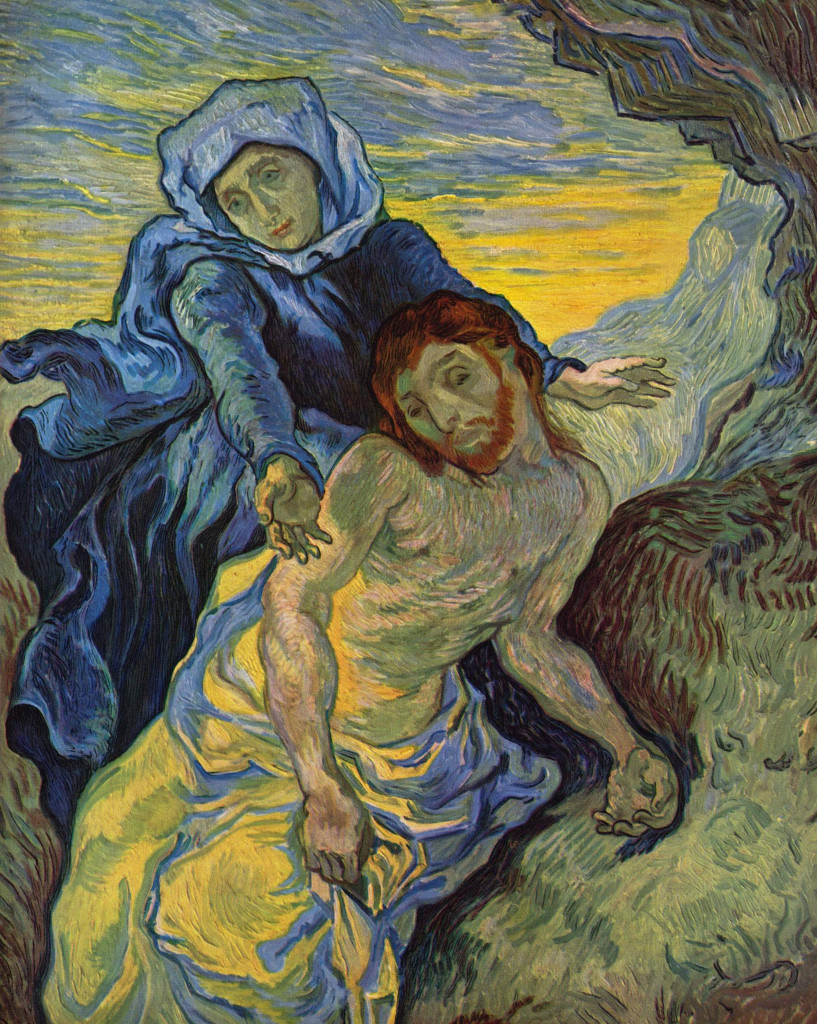
Pietà

I really like this photograph. It's so full of emotion -- the daughter's hurt and pain, the mother's relief, their faces pressed close together reminiscent of those twin Greek theatre masks, one happy, one sad. I think the Guardian picked this photo to illustrate the headline, this horrifyingly surreal thing that feels so much like the wheels of history grinding themselves against a dirt road that the paragraph in a 2050 textbook subtitled "FACTORS LEADING TO ______" is almost tangible, because of its inadvertent allusion to the Pietà.


From top to bottom: Michelangelo 1498, Van Gogh (after Delacroix) 1889, Delacroix 1850, Bouguereau 1876.

The photograph, taken spontaneously of course, that decisive moment as Cartier-Bresson called it, evokes every Pietà and evokes the intensity of that Biblical moment. The two bodies are entwined, cradled together, the composition forming a softly triangular amorphous idea of pain. Yet whilst the Pietà, which depicts Mary holding Jesus' dead body, is the ultimate expression of grief and suffering, Kelly's photograph is one of ultimate joy and happiness –– after grief and suffering, and in defiance of grief and suffering. As the mother and daughter greet one another, so countless other families remain separated by the ban. And yet, an image of hope under a headline of despair. 

And of course there is irony in this. A classic icon of Christianity reincarnated in two Muslim women, in the context of a ban on all entry from certain Muslim countries except for minority Christians being persecuted, by executive order of a disgusting Islamophobe (amongst other things) who is now the head of a country that prints IN GOD WE TRUST on their money, their sacred money that they worship like God, on Holocaust Remembrance Day, remembering Jews killed over God (and Rroma and gays and disabled people and communists and everyone seen as an enemy to the purity of the "aryan race"). This new Pietà is defiant because it dares to emulate Christ and the Virgin Mary, Christ who is a prophet in Islam -- Islam, which has since its inception been despised by Christianity, the religion seen as one of doom, hatred, and destruction, for little reason other than having been created and knocking at Christianity's doorstep, the religion whose simple existence strikes fear in Christianity's heart and is construed as its opposite, mighty yet savage, a bloodthirsty monster. Kelly's picture shows beauty, tenderness, nobility, elegance, a wry tableau that speaks out against hatred. In the photograph, it is the child holding the mother, who is in a wheelchair. Make of it what you will. 


***
Oh, and, some more Kenneth Chan: 

jeudi 12 janvier 2017

Response to Sir Thomas Lawrence’s portrait of Amelia Angerstein and her son John Julius William


Wrote this for my application to History of Art at St Catherine's College, Oxford. Was meant to write a 750-word response to a picture to which I had first-hand access. This went through quite a few drafts, including some hasty iPad typing while on a school trip to London right before the deadline.


Portrait d’Amelia Angerstein Lock (1777-1848), épouse de John Angerstein, et de son fils aîné John Julius William (1801-1866)
Sir Thomas Lawrence (Bristol, 1769 –– Londres, 1830)
1799; 1803 (pour l’enfant)
Huile sur toile
Musée d’Art et d’Histoire, Genève, Suisse


Response to Sir Thomas Lawrence’s portrait of Amelia Angerstein and her son John Julius William

Jiaqi KANG

Written work
Applicant for History of Art (V350) at St Catherine’s College
International School of Geneva, Campus des Nations

This essay will examine the portrait of Amelia Angerstein and her son, John Julius William, by Sir Thomas Lawrence. Amelia was the daughter-in-law of John Julius Angerstein, the wealthy trader whose art collection would later form the nucleus of the National Gallery. Angerstein was part of a new class of merchants profiting from the emergence of capitalism whose wealth was not inherited but amassed. His extended family commissioned many paintings from Lawrence, the most fashionable portraitist of his time, as clear demonstration of their assets and affirmation of their status.

The portrait of Amelia and her son was originally painted in 1799, the year of Amelia's marriage, and in 1803 was changed "pour l'enfant". Evidence of the addition can be found in traces of brushstrokes beneath the child that suggest he was overpainted onto the folds of his mother's dress. A waxiness in some areas shows signs of thick layers of paint having been scrubbed with turpentine and subsequently covered. As an upper-class woman of the time, Amelia's fundamental role would have been to produce heirs. The painting thus highlights her fertility as a valuable family asset. In 1799, the potential of her motherhood is evidenced in the fact that her womb, covered by an ambiguously billowy dress, forms the focus of the composition where one might expect the subject's face; and in 1803, John Julius William was indeed the embodiment of her fertility. As the eldest son of the eldest son, he and the woman who produced him were significant enough to Angerstein to warrant a life-size portrait.

In 1810, Lawrence would make a chalk drawing of Amelia nursing an infant where her arm, forming a familiar heart symbol, envelops the child with warmth. Yet here, Amelia's image was not altered during the reworking, rendering her strangely unresponsive; there is no corporeal communication between Amelia and her son, with the latter pushed into a corner so that he is half-enveloped in the chiaroscuro of the heavy Romantic landscape. The shadow cast by the child's left hand is made of quick strokes whose dark tones seem inconsistent with the soft shades in the rest of the painting and whose vague shapes flatten his image, disconnecting flesh and cloth. The perfunctory manner in which the child is added deepens an emotional rift between the two subjects that fails to inspire appreciation from the audience.

In other ways the painting is relatively ordinary: it follows the contemporary trend of placing portrait subjects within a vaguely classical context to bestow upon them a sense of timeless divinity. It also demonstrates the nouveau riche desire to 'prove' one's status by showing an appreciation for the same arts favoured by the aristocracy. That the Angersteins could afford to wear white, a colour so difficult to clean, was another signifier of wealth. Despite these aims toward grandeur, however, the portrait differs from conventional images of affluence. Unlike Gainsborough's Mr and Mrs Andrews, where an imminent storm presages the fertility of the vast green fields that occupy the largest part of the canvas, Amelia is disconnected from her setting. The Angersteins' wealth is not tied to their estate, but to their enterprise. Amelia's clothing remains untainted by the soil beneath her feet - she appears to float. The setting itself, with its blurred details and vignetting, serves only as a contrast to the subjects' paleness (an inevitable result of a life of luxury and leisure, free from menial work) instead of expressing ownership.

Although seemingly an ordinary portrait on first glance, it in fact reflects an age that saw the rise of a new type of upper-class that made their fortune from trade as Britain expanded across the globe to become the major imperialist power with a thriving economy. The portrait and others were commissioned in an attempt to affirming and immortalising their status, a natural part in the process establishing a dynastic legacy for the Angersteins.

From a twenty-first-century feminist viewpoint, however, Amelia can be perhaps be viewed with a sense of alienation. Disconnected from her child and her surroundings, she gazes out at the viewer in a passive manner, as if jaded, or resigned. The key expectation of a woman of her status was simply childbearing and never to work. Thus isolated in the upper echelons of society, women like Amelia Angerstein had little opportunity for personal fulfilment. This apathy is perhaps inadvertently expressed in Lawrence's portrait.


mardi 3 janvier 2017

The Future & A Chinese Meme


I find it such a strange feeling –– that I have no idea where I'll be this November. Only 2 out of 10 college decisions have come in so I still don't know where I'll be going. I could be in the UK or in the US. This September I could either still be chilling at home reading books, or I could have started my first semester at an American college... This is the first time I don't know what the future looks like! And the feeling is weird but very cool! I can't visualise anything beyond the summer! It makes me feel like:


Cy Twombly
Untitled (1970)

and:


Jean-Michel Basquiat
Untitled (1981)

and:


Wassily Kandinsky
Composition X (1939)

Abstract and colorful and active and vibrant and also a little shaky and scared!


***

Today in the Sine Theta group chat we talked about a lot of things, actually, but one of the points we raised is something I've been thinking about a little (but not too much because then I go ?????? I'm not very good at having conversations with myself, which I guess is just thinking. When I grapple hard concepts I need to talk it over with someone else. I can't be a philosopher. I can be a... co-philosopher.) 

It's this video that is an online parody video from China. It's very funny to me, but the context is so specific and complex that it's incredibly difficult to explain. 

When they dub foreign, especially American, media into Mandarin, there's a special voice they use. Especially older media, like 90s, maybe, early 2000s. And especially nature documentaries, or just documentaries in general... You don't hear it as much in contemporary dubs. You don't turn on My Little Pony and hear people speak like this. But some dubs, many dubs are like this –– enough to make a meme about it. 

The inflections in these dubs are very specific. The tones seem quite exaggerated. And they use more complex vocabulary. Syntax that wouldn't be used colloquially by native speakers. The video translates actual Chinese dramas into these "foreign dubs". 

So why do these dubs sound like this? We talked about it a little and wondered if it had to do with English (and most languages in general) being atonal, but Mandarin being tonal. The emotional tones in English are very strong, because tones are malleable. In Mandarin, emotional tones are more subtle, because you can only inflect your voice to a certain extent. When these dramatic inflections in English are translated into Mandarin, voice actors will try to mimick the original, but it just sounds comical to a Chinese ear. 

The parody also refers overly to "god" (上帝) for comedic effect, because foreigners are seen as constantly talking about God. God in China is a foreign concept, I think. There is Buddha, and there are various mythological deities, but they don't have the omnipotence and omniscience that an Abrahamic God does.

And I wonder if the English-language equivalent to this phenomenon is the "Orientalised" language that is often used when translating Chinese into English. A vocabulary and syntax that just sounds Oriental. Like: "twenty-six malignant gates". Malignant, instead of bad, or evil. Gates, not doors, portals. Or translating names literally, like 兰花 becoming Orchid Blossom and 明珠 Precious Pearl. Or, I don't know: "Uphold the Fires of the Glorious Socialist Revolution." It sounds very stiff. I can't really explain this either, but there's definitely a linguistic pattern.
Edit: On Jan 4th, a Guardian article quoted the Global Times as saying: "May the arrogant Americans realise that the United States of America is perhaps just a shooting star in the ample sky of history." It sounds so incredibly stiff and foreign when phrased like this. Probably because it's translated word for word. Already "These arrogant Americans should realise that the USA is just a shooting star in the ample sky of history" is a lot less alienating. But I guess it sounds less formal or whatever. I don't know. I'm not equipped to analyse stuff like this. But constant such attitudes of translation construct this image of China and Chinese being all like this, speaking in inextricably foreign ways.

Both of these are ways of Othering, perhaps. They translate while retaining the inherent foreignness of the source text. 

It's all very interesting.